
“Every” is a small but very common word in English. Although it looks simple, many learners still make mistakes when using it in sentences. Understanding how to use “every” correctly will help you speak and write more naturally, especially in daily conversations and academic contexts.
In this article, you will learn what “every” means, how it is used, common mistakes to avoid, and practical examples you can apply right away.
1. “Every” – Basic Definition and Grammar
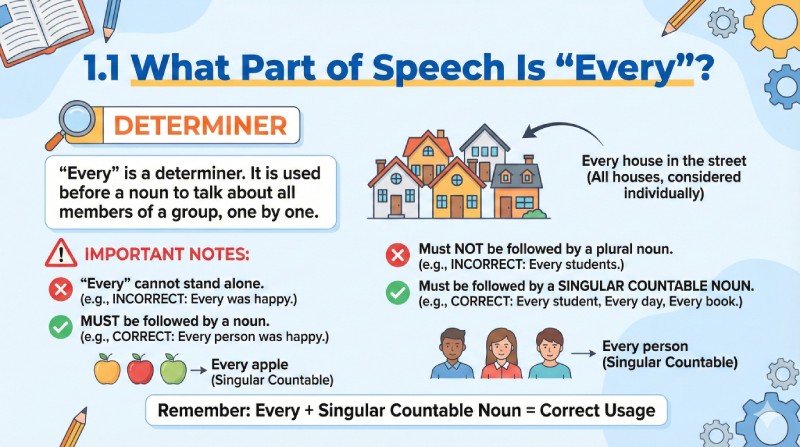
1.1 What Part of Speech Is “Every”?
“Every” is a determiner. It is used before a noun to talk about all members of a group, one by one.
Important notes:
-
“Every” cannot stand alone
-
It must be followed by a singular countable noun
1.2 Basic Structure of “Every”
Every + singular noun
Examples:
-
every day
-
every student
-
every lesson
Incorrect usage:
-
every students
-
every days
Even though “every” refers to more than one thing, the noun after it is always singular.
2. Common Uses of “Every”
2.1 Talking About All Members of a Group
“Every” is often used to emphasize that all individuals in a group are included, with no exception.
Examples:
-
Every child deserves a good education.
-
Every employee must wear an ID badge.
In these sentences, the focus is on each individual person, not just the group as a whole.
2.2 Talking About Frequency or Time
“Every” is very common when talking about repeated actions or habits.
Examples:
-
I wake up early every morning.
-
She drinks water every hour.
-
We have a meeting every Monday.
This use helps describe routines and regular schedules clearly.
2.3 Emphasizing Completeness
“Every” can also be used to stress that nothing is missing.
Examples:
-
Every detail matters in this project.
-
Every mistake is a chance to learn.
Here, “every” adds emphasis and importance to the noun.
3. “Every” vs Similar Words
3.1 Every vs Each
Although “every” and “each” are similar, they are not always interchangeable.
Examples:
-
Every student needs motivation.
-
Each student received a different task.
3.2 Every vs All
“All” is used differently from “every”.
-
Every + singular noun
-
All + plural noun or uncountable noun
Examples:
-
Every book is interesting.
-
All books are interesting.
-
All information is important.
4. Common Mistakes When Using “Every”
4.1 Using Plural Nouns After “Every”
Incorrect:
-
every days
-
every students
Correct:
-
every day
-
every student
4.2 Using “Every” Without a Noun
Incorrect: Every is important.
Correct: Every rule is important.
“Every” must always be followed by a noun.
4.3 Verb Agreement Errors
Even though “every” refers to many people or things, the verb is always singular.
Examp
-
Every child needs support.
-
Every answer counts.
5. Practical Examples in Daily English
5.1 Simple Sentences
-
Every morning starts with a fresh cup of coffee.
-
Every lesson helps you improve.
5.2 Questions
-
Do you exercise every day?
-
Is every student ready for the test?
5.3 Negative Sentences
-
Not every problem has an easy solution.
-
Not every opinion is correct.
6. Tips to Remember How to Use “Every”
-
Always use a singular noun after “every”
-
Use a singular verb
-
Think of “every” as meaning each one, without exception
If you remember these three points, you will avoid most common mistakes.
7. Practice Exercises
Exercise 1: Choose the correct option
-
Every student ___ responsible for their work.
a) are
b) is -
I read a book every ___.
a) days
b) day
Answers: 1.b – 2.b
8. Conclusion
“Every” is an essential word in English that helps you express completeness, routines, and emphasis. By remembering its structure and common uses, you can avoid typical mistakes and sound more confident when speaking or writing English.
Practice using “every” in your daily sentences, and soon it will feel completely natural.